ContentsBrowse sections
Preserving a grant decision’s history, explaining its grounds and authorizing a correction require different powers. The Canada Council for the Arts provides a case for comparing how DAO-inspired arrangements would change those powers while retaining contextual assessment and public purposes. A documentary account of the Council’s published arrangements and descriptive analysis of its award records ground a comparison of an unsuccessful application and a disputed payment condition.
Under the stipulated designs, independently held records can resolve a disagreement about decision history while correction still depends on an authorized review procedure. Community advice can contribute context to programme design; binding votes would change the grounds and authority for allocation. A programmed payment gate can constrain departure from an accepted instruction while increasing the importance of certification and correction. Following the same decision through these alternatives identifies which relationship a proposed reform would change and where ordinary administrative improvements can supply the same capacity. The comparison establishes consequences under its design assumptions; practical improvements at the Council remain to be evaluated.
1. The grant-making question
An arts grant is several decisions before it becomes a payment. An application must be eligible, assessed against a programme’s purposes, considered within a budget and approved by someone with the relevant authority. An unsuccessful applicant may want to understand the judgment or question whether the assessment followed its rules. A funded artist may later need an agreed condition changed. Public scrutiny must coexist with the confidentiality of proposed work and the contextual knowledge on which peer judgment depends.
DAO arrangements can delegate voting influence, authorize collective action and make selected changes independently inspectable, with varying organization and autonomy (Hassan and De Filippi 2021). Programmed transfers can restrict execution after a condition is accepted. Applying these mechanisms to public arts funding requires deciding whose judgment counts, what an applicant is owed and who can act when an obligation is disputed. The comparison follows those relationships through changes to records, participation and payment rules.
The case is valuable because these relationships are already differentiated. The Council’s peers generally assess and rank applications; staff determine amounts within budgets; financial approval follows delegated authority. Its published guidance distinguishes dissatisfaction with a funding decision from evidence of a procedural error during assessment (Canada Council for the Arts n.d.-b). Replacing an approval with a vote, changing access to a record and introducing a new review procedure therefore change different parts of the institution. The analysis follows those changes through specified situations, rather than treating the presence of a public transaction as an overall measure of accountability.
Each proposed change is assessed against a specified alternative and the authority needed to use it. A stronger record may supply evidence, a new constituency a different allocation judgment, and a payment gate a constraint on execution. An enhancement claim must connect the added capacity to an obligation and a response available to the people affected.
2. Accountability and the closest design work
Accountability concerns a relationship in which an actor is obliged to explain conduct to a forum able to question and judge it, with possible consequences (Bovens 2007). The forum need not itself execute every consequence. The worked cases examine a narrower question within that relationship: which actor can respond to an established procedural defect or mistaken certification. This makes the object of explanation important. The public may need to know where money went, an applicant may need to understand an assessment, and a reviewer may need evidence of whether a required step occurred. The same disclosure does not serve every purpose. Fox’s (2007) distinction between transparency and accountability helps explain why publishing a record can improve observation without establishing an effective response.
DAO research already addresses the organization of decision rights and responsibility. Beck et al. (2018) place decision rights, accountability and incentives within blockchain governance. Crepaldi (2019, §6) distinguishes recognition, adjudication and change through secondary rules: recognizing an authoritative decision, deciding a dispute and changing a rule are separate institutional functions. A follow-up vote can make a new decision without adjudicating whether the previous one complied with an obligation. These established distinctions guide the application and payment comparisons.
DuPont’s (2018, 164–172) historical account of The DAO likewise follows the social and organizational work surrounding an ostensibly autonomous arrangement. The lesson for a grant design is to examine how an instruction becomes authoritative and how intervention occurs, alongside the instruction’s formal execution. The existence of code cannot settle that institutional account.
Public-funding designs already combine collective choice and execution. Diallo et al. (2018) develop an e-government DAO prototype for selecting service providers. Rikken et al.'s (2022) DACPO design gives a community control over participation, budget decisions and approved payments. Its expected benefits are proposed rather than measured in an operating municipal intervention. These designs establish precedents for combining collective choice and execution, while leaving the public purpose and source of each authority consequential.
The closest grant-making study is Lustenberger et al. (2025). Their action design research concerns internal research funding at a Swiss university. Expert screening, community participation and final board authority already coexist in the process they examine. Workshops refine a design organized around submission, selection, voting and execution, including score feedback and a period for concerns before the board decides. The authors explicitly leave live implementation outside their evaluation. Their stakeholder-grounded work is stronger evidence for that institution’s design requirements than the documentary method used here can provide for the Council.
Lustenberger et al. adapt a DAO withdrawal mechanism into an opportunity to email concerns. The adaptation preserves a chance to object while changing the objector’s power: withdrawing an asset entitlement before execution differs from asking a board to consider a concern. Evaluating the design therefore requires following the procedure proposed and the response it authorizes.
In public grant-making, a vote about allocation, an applicant’s challenge to an omitted assessment and an official’s financial approval have different grounds and consequences. Following the same decision through redesigned arrangements makes their effects comparable, including what ordinary administrative reform could accomplish.
Community design also requires more than importing a voting rule. Van Vulpen and Jansen (2023) develop a conceptual account of DAO design for commons and the common good, including expertise, external legal recognition and revisable rules. Rozas et al. (2021, 6–7) already identify the danger of moving power to programmers and of changing a rule only after its automatic enforcement has caused harm. The Council case makes those established problems specific: which community contributes knowledge, which decisions it may change and what response remains available after an erroneous action. A token electorate, a professional peer group and a community identified by a programme’s cultural purposes cannot be treated as interchangeable populations. Nor does scarcity alone make a public grant budget a community-owned common-pool resource.
3. Evidence and the Council case
3.1. Method and scope
The study combines three kinds of material whose inferential roles remain separate. Council publications establish stated arrangements at the dates consulted. Commissioned research supplies reported experiences within its own sample and period. Published award records support descriptive calculations about the records' amounts and composition. None supplies an evaluated DAO intervention at the Council.
The design comparison specifies alternatives and follows two stipulated situations through them. The application comparison distinguishes a request to understand contextual judgment from a claim that a required assessment step was omitted. Accepted and disputed record histories are examined as separate conditions applied to each alternative. The payment comparison concerns a disagreement about an administrative condition for a later transfer. These situations distinguish explaining a judgment, establishing a procedural record and responding to a defect, then executing an instruction and correcting its input. They are not reports of Council incidents. They test the internal consequences of the proposed arrangements; they cannot establish how often a problem occurs or how people would experience a reform.
The comparison follows specified acts and powers. An award record’s traceability, an applicant’s route to procedural review and a token holder’s voting influence concern different objects. A common interval scale would require comparable observations and a justification for the distances between scores. The available records supply neither. Descriptive calculations retain explicit observation units; the proposed changes are examined through the consequences of their stated rules.
3.2. Judgment, authority and information
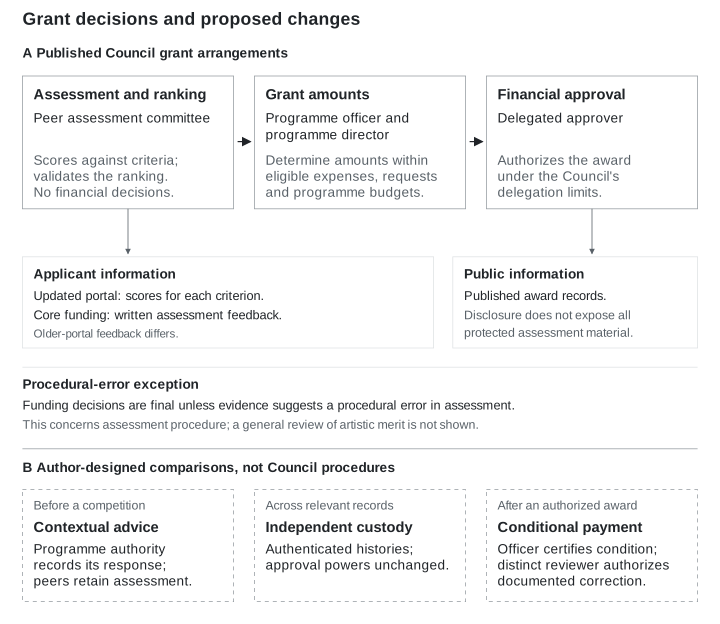
The Council describes three stages: assessment and ranking, determination of amounts, and awarding funds. Peers generally assess against programme criteria and recommend funding; they do not make financial decisions. Staff determine amounts within programme budgets and the Council’s approval structure. Some applications without an artistic criterion can be assessed internally (Canada Council for the Arts n.d.-b).
This division does substantive work. An artistic ranking and a financially approved amount answer different questions. Requiring an explanation for a departure from a ranking would alter a relationship between the stages. Giving an additional constituency final power over individual grants would alter the allocation of authority. Publishing the final amount would leave both questions open.
The Council’s funding principles connect peer assessment, stewardship, equity, Indigenous cultural self-determination and an arm’s-length relationship with government (Canada Council for the Arts n.d.-c). Expertise cannot therefore be treated simply as a barrier to participation. Assessors may supply knowledge of artistic practice, cultural context and an applicant’s developmental circumstances that a public vote does not elicit. Confidentiality can protect candour while also making parts of the judgment difficult to inspect. The appropriate question is what explanation an affected person needs, and how it can be supplied without assuming that all deliberation should become public.
Imprint Consulting’s commissioned report examines staff and peer-assessor experience largely from April 2022 to March 2024. It received 507 survey responses from 1,070 invited peers, alongside interviews and focus groups. The report describes tensions between consistent procedures and flexibility for committees, differences in which applications receive discussion, and concerns about feedback and the integration of scoring tools (Imprint Consulting 2024, 8–20, 25–29). These findings supply concrete design concerns. They do not establish that every application lacks discussion or feedback, and they do not measure unsuccessful applicants' experiences.
Current published guidance must be read alongside that earlier evidence. Applications through the updated portal receive criterion-level scores; core funding also receives written feedback. Older-portal applications generally lack the same breakdown outside core components. Funding decisions are described as final, with an exception where evidence suggests a procedural error during assessment (Canada Council for the Arts n.d.-b). The public guidance establishes an important distinction between merit and procedure, but does not fully describe how a particular challenge is handled in practice.
The May 2026 evaluation of funding for Official Language Minority Communities adds applicant and recipient perspectives. Its survey received 176 responses from 347 contacts, including unsuccessful applicants. Reported demand for useful feedback concerns application experience through the older portal; the report also notes recent improvements in outcome resources. Its account of peer assessment is particularly relevant here: when an assessor withdraws because of a conflict, knowledge of a community’s circumstances can be lost from the discussion (Imprint Consulting 2026, 19–20, notes 17 and 19). Protecting impartiality and retaining relevant knowledge are both institutional concerns. Neither an authenticated score nor more public voting necessarily resolves their tension.
The July 2026 portal guide describes linked application and award management, reporting, payments, assessor activity and support cases. Those published functions are part of the current administrative alternative, not innovations to be attributed to a hypothetical ledger. Support cases do not by themselves establish a review power. The Council’s active Info Source bank also identifies assessment rationale and notes among its records, while language about requesting discussion summaries appears in inactive legacy entries (Canada Council for the Arts 2026b, 2026a). Public disclosure, protected applicant access and internal record retention must therefore be distinguished; the legacy wording cannot safely be promised as a universal current entitlement.
The Council’s institutional status also limits casual transplantation of rules from federal departments. Its Act specifies its objects, audit and reporting arrangements, and states that it is not an agent of the Crown; its members and staff are outside the federal public administration, subject to the stated exception (Department of Justice Canada 2026, ss. 8, 12, 20–21). This paper does not infer the applicability of a particular departmental policy from public funding alone. Its proposed changes remain designs for analysis, not legal findings about what an actor may currently do.
3.3. What the award records establish
The current cumulative export contains 65,002 published rows for fiscal years 2017–18 through 2024–25, with recommended amounts totalling CAD 2,515,602,894.67. The additional 2024–25 year has 6,725 rows and CAD 282,576,453. Historical annual counts and amounts agree with the retained 2017–2024 export (Canada Council for the Arts n.d.-a). All published rows are retained, including 57 exact repetitions beyond their first occurrences: the file has no unique award identifier that would establish whether these are duplicates or distinct identical awards.
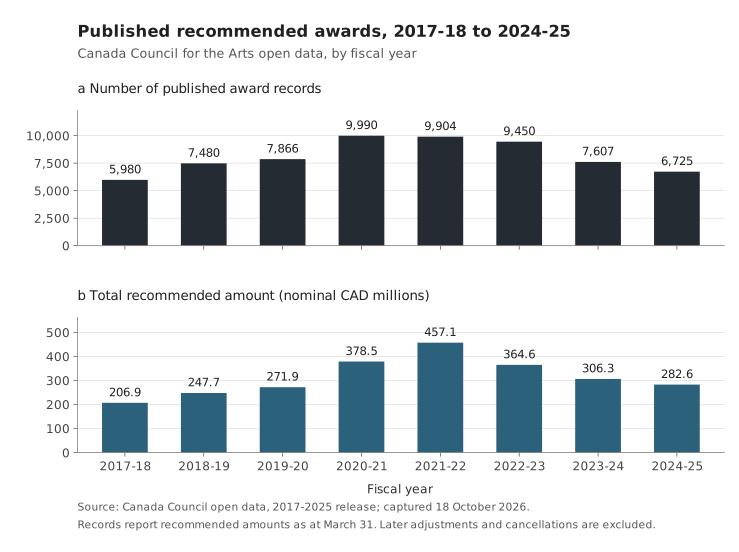
The methodology describes amounts recommended as at 31 March, with scope exclusions and limits on later adjustments (Canada Council for the Arts n.d.-d). These records are useful for understanding the scale and composition of published decisions. They are not the application population. The 2024–25 Explore and Create competition workbook likewise contains funded recipients; it does not add unsuccessful applications, scores, reasons or procedural challenges. A success rate, fairness judgment or remedy rate cannot be calculated from those files (Canada Council for the Arts n.d.-a).
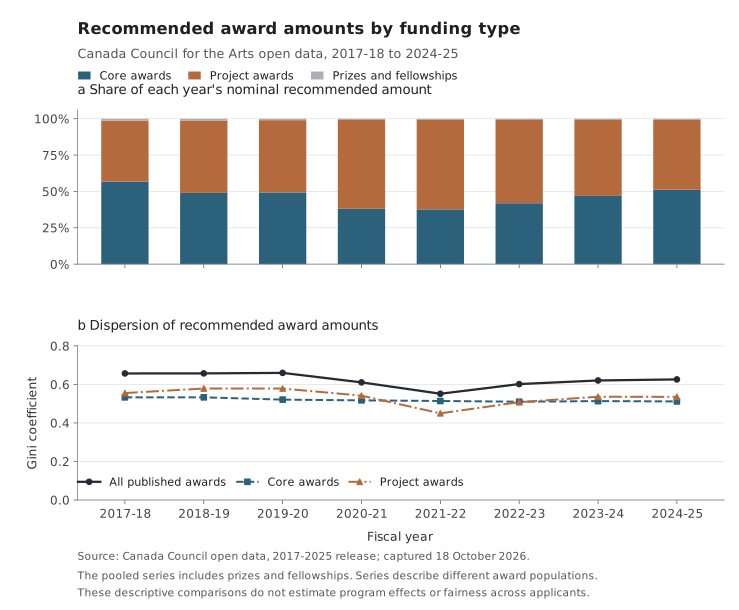
Award-size dispersion describes the published portfolio, whose awards can finance different purposes and durations. Explaining a change requires examining the funding rules, population and decisions that produced the records. A temporary reduction does not establish successful administrative reform or a later failure of political commitment. Durability must be investigated through commitments and amendment authority; assessment quality and fairness of access require their own observations. Appendix A retains the detailed distribution and overlapping-export comparisons.
4. Comparing changes to the grant process
Changing a record’s custody, adding programme advice and constraining payment execution alter different relationships. Comparing them separately keeps assessment and financial authority visible and allows each proposed benefit to be tested against an equivalent administrative alternative.
| Arrangement | Specified change | What remains to be justified |
|---|---|---|
Improved institutional records and review |
The institution retains peer assessment and financial approval. Authenticated versions identify submission, assessment and approval; applicants receive relevant protected records. A defined review procedure can respond to an established procedural defect. |
The review procedure’s grounds, authority and effect are design assumptions, not a claim about an existing universal entitlement. Usability and trustworthy custody require evidence. |
Independently witnessed records |
The same decision and review roles remain. An applicant and an independent custodian hold authenticated receipts or attestations of relevant record versions. A shared ledger is one possible implementation. |
Who can attest, which history is disputed, what protected material is retained, and why signatures or ordinary independent archives are insufficient for the task. |
Programme-level community advice |
A rotating panel supplies contextual briefs and recommendations on programme priorities before individual applications are assessed. The programme authority records its response. Peers retain individual assessment, and the panel cannot direct individual awards or decide procedural challenges. |
The panel’s selection and mandate, accessibility, conflicts and influence on programme choices. Its advice creates no power to correct an individual result. A binding allocation vote would be a different design. |
Programmed conditional payment |
After an authorized award, a transfer instruction acts on an authenticated statement that a defined administrative condition is met. Disagreement can pause the instruction under a specified procedure. |
Control of funds; who certifies, pauses and corrects; authorized exceptions; recovery after an erroneous completed transfer; and the cost of restricting change. |
The first arrangement is intentionally a strong conventional alternative. A new procedure with clear records and a competent response can be valuable without collective on-chain governance. The second changes evidence custody while holding authority fixed. It would not, on that basis alone, constitute a DAO. The third changes how contextual knowledge enters programme design, while the fourth changes execution. They can be combined, but an argument for one does not establish the others.
For the advisory alternative, stipulate a programme-specific pool formed through accessible self-nomination, followed by a stratified draw under published practice, region and language-coverage rules. Members have fixed terms, compensation and accessibility support, with disclosed conflicts. Minority positions remain in the record. They advise using programme-level material rather than confidential individual applications. Before the next call, the programme authority publishes whether it accepts, declines or revises each recommendation, with reasons. These are analytical assumptions, not an established optimal recruitment method or a template for every cultural community.
The Council already works with stakeholder organizations and supplies context briefs; the 2026 evaluation recommends updating those briefs through collaboration. The panel therefore cannot be sold as a DAO innovation or as a response to an assumed absence of community input. Its specified selection and response duties make it an alternative that can be compared with current consultation. The same panel, duty and records can be implemented with ordinary tools. A DAO implementation would need to establish a further relevant capacity rather than inherit the value of the advisory process itself.
4.1. Following an unsuccessful application
Begin with an applicant who wants to understand a low score for work situated in an official-language-minority community. The assessment is assumed to have followed the required steps; the question is whether the explanation makes clear how relevant context entered the judgment. This stipulated situation develops the 2026 evaluation’s concern without asserting a particular incident. A verified score proves that a value was recorded, but cannot explain its grounds. A protected explanation may connect the criterion, the relevant context and the comparative judgment, subject to what can appropriately be disclosed. More records are useful only if they supply that connection.
The advisory panel can help before the decision by contributing contextual briefs and questioning programme assumptions. A recorded institutional response makes its influence open to examination. It can supply some shared context after a recusal, but cannot ensure that a particular assessor has or uses the case-specific knowledge required. It has no power to reopen an individual artistic judgment. A panel drawn from already well-connected volunteers may also reproduce the knowledge gap. Its selection rule and the assessment process must therefore be examined as part of the proposal. This is a different contribution from granting every applicant another vote.
Now assume an eligible application was omitted from a required assessment step and receives an unsuccessful result. This changes the object of challenge from understanding a judgment to identifying a procedural defect. It does not assume that every application must receive the same discussion. At issue is whether the required step occurred for this application, what evidence can establish that, and what an authorized reviewer can do if it did not.
In the improved institutional arrangement, an applicant receives a submission receipt and criterion-level outcome information. A review record links the application to the required assessment, the recorded result and the subsequent approval. If a trusted custodian can produce these records and the review procedure can establish and respond to the omission, the applicant’s difficulty is not a missing blockchain. It may instead be finding the route, understanding the explanation or obtaining a timely response. Cordella and Tempini’s (2015, §6.1) account of public-service routing and professional judgment supplies a substantive rival to organizational replacement: information systems can reorganize what officials see and do while retaining a bureaucratic division of responsibility.
Now change the situation so that the dispute concerns which assessment version existed before approval. Apply the same disputed-custody condition to each alternative: the institution’s copy is disputed, and an authoritative chronology must be established. An institution-only record leaves the reviewer dependent on that keeper. Signed receipts and an independently administered archive can establish another copy; a distributed attestation arrangement can do so across several defined custodians. Either alternative depends on authenticated roles, protected underlying material and a rule for resolving inconsistent attestations. A ledger is useful only if its particular coordination or verification properties address a requirement the simpler independent archive cannot meet.
A submission receipt establishes receipt, not assessment. Demonstrating an omission also requires a complete record of the assessment step’s required scope and completion; absence from a partial log would not suffice. A bare public hash cannot supply those records or recover a lost document. The review procedure, rather than the shared history, determines the consequence of an established omission. If the custody of the underlying material or the attesters' accounts is also unreliable, both independent arrangements can fail despite preserving an authentic commitment.
Shared verification can help settle a disagreement about record history across parties who need independent evidence. Its value declines if signed receipts and a trusted external archive already resolve that disagreement at lower burden. The Council sources reviewed do not establish that the hypothesized custody failure occurs there. The result concerns the alternatives' capacities under the specified conditions.
Giving a community body binding power over individual awards would change the comparison. It could support a new award for the unsuccessful applicant. Unless the procedure expressly gave it jurisdiction over the original omission, it would make a new allocation rather than determine whether the earlier assessment was defective. It could also change the position of other applicants competing for the same budget. The advisory panel specified here has no such power. A reconsideration vote needs specified grounds and effects on all affected applications before it can serve as a review mechanism.
The appropriate participatory role depends on the object of judgment. Community input may help define programme priorities or identify missing context; a binding vote on individual applications needs a separate justification for who participates and how their influence relates to programme purposes. Polkadot’s documented delegation by track makes a useful design possibility visible: participation can be specialized rather than requiring everyone to decide everything (Polkadot 2026a, 2026b). Assigning an account’s voting influence, however, does not confer the duties or limits of a financial approver. Revocability can make a delegate responsive to the delegator while leaving a non-delegating applicant without a route to question that delegate’s conduct.
Quadratic funding makes the change in allocation grounds especially clear. Buterin et al. (2019) formalize a mechanism in which the breadth and size of contributions affect matching allocations. Adapting it to public arts funding would require deciding whose support should count, which contributors can participate and which public purpose the matching budget serves. A professional peer assessment and contribution breadth can each express relevant information, but they answer different questions. Combining them requires an allocation rule that explains their relationship; calling the combination a transparency reform does not supply it.
4.2. Following a conditional payment
Consider an authorized award whose later payment requires receipt of an agreed administrative report. This condition is chosen because submission can be recorded without assuming artistic quality is automatically measurable. Assume the grantee submits the report, but the certifying officer records it as missing. Both the ordinary and programmed alternatives initially rely on that statement. In either design, an error at certification can withhold money despite a correctly functioning payment system.
The Council methodology already describes conditional payments for reporting requirements (Canada Council for the Arts n.d.-d). For the proposed programmed alternative, stipulate funds reserved for the award and controlled by an instruction that a payment operator cannot bypass unilaterally. A designated officer can certify receipt; a distinct reviewer can authorize a documented correction or exception after examining the underlying record. Both actions must be authenticated. The instruction can then prevent an operator from releasing the reserved funds without an accepted certification or exception. If the same operator can transfer the funds outside that path, this constraint does not hold. The paper does not establish that reserving or controlling public funds in this way is legally or operationally available at the Council.
Give the ordinary alternative the same reserved budget, certifying role, review power and correction procedure. Both can then correct the mistaken withholding. The possible programmed difference concerns resistance to unilateral departure from the accepted instruction, rather than a new right to correction. An ordinary system with an equally effective separation of duties could supply that protection too. An incremental advantage would have to arise from a specific coordination or verification requirement, such as several independently administered custodians needing to execute the same accepted instruction. Whether that arrangement is worth its cost and risk remains unmeasured here.
If neither the certifier nor a reviewer can correct the accepted statement, and the gate admits no relevant exception, the error persists until the governing rule changes or control is exercised outside it. Faithful execution can therefore preserve an erroneous condition, as the earlier commons literature already recognizes for automatic harm (Rozas et al. 2021, 7). An override broad enough to bypass every condition can instead weaken the proposed constraint. A coherent design must define who can pause or correct, what they must record, when the grantee can obtain a response and what happens if they fail to act. Publishing the override history permits scrutiny of its use without settling whether the authority is appropriately distributed.
Completed erroneous transfers present a further problem. Pausing an unsettled instruction, recovering money already paid and compensating someone wrongly denied payment require different actions and resources. A later vote cannot be described as recovery unless the funds can actually be recovered or replaced under the specified arrangement. These consequences must remain visible when a payment mechanism is called a sanction. A rule that blocks a transfer for non-compliance and a procedure that penalizes misconduct do not necessarily act on the same person or conduct.
Changed circumstances differ from an erroneous certification. A project may have a justified reason to alter a report date, or a later round may adopt new criteria. Record preservation, amendment of an existing obligation and amendment of future rules require separate decisions. Restricting an unrecorded departure from an agreed condition may be useful; making every condition maximally resistant to change can prevent a warranted accommodation. The relevant durability is continuity of an identifiable obligation through accountable revision, rather than an assumption that rules should never change.
5. Contemporary DAO arrangements and revision
Current systems make the importance of these distinctions more concrete than a general contrast between code and bureaucracy. Gitcoin announced the wind-down of Grants Stack in May 2025 while continuing the grants programme. Its published GG24 design distributes decisions across domains, operators and funding mechanisms, including quadratic, retroactive and conviction-based funding (Gitcoin 2025a, 2025b). This describes an announced design rather than independently verified implementation of every allocation. The historical GR6–15 aggregates cannot stand in for this later institution. Programme continuity and software continuity are different observations, as are the choice of a domain and the allocation rule used within it.
Optimism supplies a documented example of revision to participatory arrangements. Its June 2026 governance update announced an indefinite pause of the Citizens' House. A July 2026 merged change to the Operating Manual removed Citizens' and Joint House arrangements and changed the quorum denominator to active votable supply, defined there through delegated OP with voting activity in the preceding six months (Optimism 2026a, 2026b). This verifies a change to the published governing manual, not current contract behavior or the execution of every accompanying council-dissolution proposal. Formally documented participation arrangements can change; an analysis of continuity must identify who can revise them and what happens to outstanding obligations.
Lido’s implemented dual governance provides a different correction to a crude comparison. For Lido on Ethereum, collective signalling thresholds allow stETH holders to delay motions subject to the mechanism and use an escrow-based exit process without becoming LDO decision voters. The specification includes emergency arrangements, while its risks document describes dependencies on oracles and withdrawal execution (Lido 2025a, 2025b). This is a designed protective power for affected non-voters, not an individual unconditional veto or a current contract-state audit by this study. Withdrawal of an existing asset position also differs from an unsuccessful grant applicant’s claim to an explanation or procedural review. The analogy becomes useful when the power is specified, rather than when all three are counted as contestability.
Rikken et al.'s (2023) observational study relates DAO governance characteristics to continued activity, with accountability operationalized through voting-power categories. Continued activity and an affected applicant’s ability to obtain a response to a public obligation are different outcomes. Their comparison requires retaining each study’s construct and unit of observation.
The institutional comparison supports selective use of the proposed mechanisms. Protecting relevant application and assessment records can coexist with confidential peer judgment. Community participation can be assigned to priorities or a specified allocation rather than presumed to replace every approval. Conditional execution can be examined where an identifiable coordination problem exists. Review, correction and amendment need to be specified alongside each change. The case for distributed governance depends on the capacity gained through that particular arrangement.
6. Implications for grant design
A change to records, participation or execution matters to accountability through the obligation it serves and the actor able to respond. In the worked situations, reallocation can leave a procedural defect unresolved, an execution constraint can make an attester more powerful, and independent history can remain unusable without the underlying record or a competent review forum. Designing the response alongside the new capacity makes those consequences visible before choosing an implementation.
The comparisons establish consequences under the specified design assumptions. Their importance in practice remains an empirical question. The Council’s documents and commissioned research do not measure the incidence of custody disputes, the handling of procedural challenges or the burden of an added verification system. They also do not establish which communities would authorize a new allocation role. A useful next study would begin with actual decision and review cases, with appropriate access protections, and involve applicants, assessors and staff in testing whether the proposed distinctions match the difficulties they encounter.
The empirical comparisons should then hold the institutional change constant. Comparing an improved portal with a shared-record alternative requires equivalent feedback and review powers in both; otherwise a benefit from a new procedure can be misattributed to the record architecture. Comparing a conditional-payment prototype with ordinary management requires the same condition, certifying role, correction procedure and available funds. Appropriate outcomes would include whether participants can establish the relevant sequence, understand the decision and obtain the specified response, alongside time, workload, accessibility and cost. A claim of improved fairness would require its own distributive standard and an application population that the award export does not provide.
A technical prototype could establish whether specified receipts, permissions and pauses work under the chosen threat model. It could not establish that the proposed officials have the authority to use them, that applicants find them usable or that outcomes improve. A recommendation to implement a grant system would require institution-specific legal, privacy, security, accessibility, cost and stakeholder analysis. These requirements attach to the relevant claim; they are not prerequisites for every documentary comparison. A live public-money pilot is not a necessary first step; documentary case tracing and a protected prototype can answer earlier questions with less disruption.
For this case, a design can make an assessment easier to observe while leaving its grounds unclear. A public vote can add participation without supplying the contextual knowledge needed for the programme’s judgment or the authority needed for procedural review. The specified advisory arrangement offers another route: contextual input before the competition, with an institutional response that can be followed into later criteria. Its value would come from those duties and their use, whether implemented through ordinary tools or distributed infrastructure. An enhancement claim must identify the relationship improved and the people who benefit, alongside any cost to the judgment and responsibilities the grant process must retain.
7. Appendix A. Data and interpretation
Earlier versions combined a hypothetical Council workflow with distributional analysis, delegated participation, adaptive capacity and durability. The present comparison retains those questions while separating descriptive records, analytical assumptions and measured effects. The numerical scores, radar chart, weighted variants, coordinate-wise dominance claim, and adaptive-capacity ranking are withdrawn. The former recommendation for a blockchain grant pilot is withdrawn.
The principal quantitative corrections concern units and construction. The original Polkadot Gini of approximately 0.079 describes aggregate voting power across twenty selected referenda, not inequality among voters. The Gitcoin value of approximately 0.285 describes totals across ten funding rounds, not inequality among recipients. Neither is commensurate with the Council’s award-row distribution. Reconstructed delegation totals also depend on recognizing repeated delegate aggregates within delegator records; visibility of a field does not establish its meaning. The former delegation headline of 91.7 percent is withdrawn. Population-wide inference remains withheld because indexer-field semantics and historical reconciliation remain incomplete, alongside source-to-runtime linkage for the full period.
The earlier scenario branches supply no estimated intervention effect. One contains no usable contestability or sanctionability observations; another reports identical baseline and reform values. A later branch applies fixed rubric scores and assigned increments. Reproducing those calculations would verify the configured arithmetic, while leaving the increments' empirical basis unresolved. A contestability variable that includes decision duration also cannot supply independent evidence of their association. Changing weights or resampling cannot repair either problem.
The earlier inequality charts used headline coefficients and power-function curves constructed from them. A Gini does not identify an empirical Lorenz curve. The present figures use the specified Council records, whose historical annual counts and amounts remain reproducible in the current export. Both source versions are preserved in the supporting analysis.
The source comparison also distinguishes overlapping exports. The emergency-support CSV lacks a stable standard-CSV column structure, so the companion official workbook is used with its Canada and Outside Canada sheets; provincial sheets repeat records and are excluded. The comparison reports overlap on named descriptors without asserting unique award identity. The current competition workbook is checked rather than presumed to contain unsuccessful applications. These steps extend the original analysis while restricting conclusions to what the records establish.
7.1. Distribution and publication comparisons
The Council data supplement contains the aggregate tables, source-release identifiers and code for reproducing the calculations and statistical figures.
The award-row Gini falls from 0.659721 in 2019–20 to 0.551498 in 2021–22, before reaching 0.625874 in 2024–25. Its interpretation depends on the funding mix. Excluding the named Digital Now component raises the 2021–22 value to 0.578266. The comparison does not estimate what would have happened without that programme: the remaining awards need not represent a counterfactual portfolio. A larger award can finance a different purpose, duration or type of recipient. Equality of award amounts is not a distributive standard supplied by the data.
The separately published 2020–21 emergency-support workbook supplies a further warning about treating publication surfaces as independent populations. Its 3,395 rows overlap extensively with the cumulative export. All 2,084 rows labelled COVID-19 Emergency Support Fund match on the selected descriptors. Forty-two Digital Originals rows have a single later same-name/type candidate with an amount of CAD 6,000 rather than CAD 5,000. These are candidate record correspondences, not unique-ID matches. Adding the two exports would double-count much of the same material. Differences between publication snapshots warrant investigation; they do not establish irregularity or a need for a ledger.
The current export preserves the historical annual counts and amounts. Seven paired historical row differences concern five business-number fields and two French source-link fields, without changes in the paired amounts or recipient names. These are descriptor-based diagnostics rather than unique-ID linkage. The old file has 50 exact repeated rows beyond first occurrences; the current file has 57. Retaining them preserves the published population and does not certify that each is a distinct grant.
References
Beck, Roman, Christoph Müller-Bloch, and John Leslie King. 2018. “Governance in the Blockchain Economy: A Framework and Research Agenda.” Journal of the Association for Information Systems 19(10): 1020–1034. https://doi.org/10.17705/1jais.00518.
Bovens, Mark. 2007. “Analysing and Assessing Accountability: A Conceptual Framework.” European Law Journal 13(4): 447–468. https://doi.org/10.1111/j.1468-0386.2007.00378.x.
Buterin, Vitalik, Zoë Hitzig, and E. Glen Weyl. 2019. “A Flexible Design for Funding Public Goods.” Management Science 65(11): 5171–5187. https://doi.org/10.1287/mnsc.2019.3337.
Canada Council for the Arts. 2026a. “Info Source.” Active Funding and Awards bank and inactive legacy ATS entries. Accessed 18 October. https://canadacouncil.ca/about/public-accountability/info-source.
Canada Council for the Arts. 2026b. “Introduction to the Portal.” Updated 14 July. https://canadacouncil.ca/funding/resources/introduction-to-the-portal. Accessed 18 October 2026.
Canada Council for the Arts. n.d.-a. “Data Tables.” Cumulative 2017–2025 CSV, 2024–25 Explore and Create project-funding workbook, and 2020–21 emergency-support workbook. Captured 18 October 2026. https://canadacouncil.ca/research/data-tables.
Canada Council for the Arts. n.d.-b. “Decision Making: Awarding Grants and Prizes.” Accessed 18 October 2026; publication date not stated. https://canadacouncil.ca/funding/funding-decisions/decision-making-process.
Canada Council for the Arts. n.d.-c. “Funding Principles.” Accessed 18 October 2026; publication date not stated. https://canadacouncil.ca/funding/funding-decisions/principles.
Canada Council for the Arts. n.d.-d. Stats and Stories: Key Statistics of Canada Council Funding Grant Recipients: Open Data Tables: Methodology. 2024–25 edition. https://canadacouncil.ca/-/media/Files/CCA/Research/stats-and-stories/data-tables/2024-25/en/Open-Data-Tables-Methodology-2024-2025.pdf. Undated methodology, 2024–25 release; accessed 18 October 2026.
Cordella, Antonio, and Niccolò Tempini. 2015. “E-government and Organizational Change: Reappraising the Role of ICT and Bureaucracy in Public Service Delivery.” Government Information Quarterly 32(3): 279–286. https://doi.org/10.1016/j.giq.2015.03.005. Consulted accepted manuscript, §6.1. https://eprints.lse.ac.uk/62121/1/E-government_and_.pdf.
Crepaldi, Marco. 2019. “Why Blockchains Need the Law: Secondary Rules as the Missing Piece of Blockchain Governance.” In Proceedings of the Seventeenth International Conference on Artificial Intelligence and Law, 189–193. ACM. https://doi.org/10.1145/3322640.3328780. Consulted accepted manuscript, §6.
Department of Justice Canada. 2026. Canada Council for the Arts Act, R.S.C. 1985, c. C-2, ss. 8, 12, 20–21. Current to 30 September 2026. https://laws-lois.justice.gc.ca/eng/acts/C-2/FullText.html.
Diallo, Nour, Weidong Shi, Lei Xu, Zhimin Gao, Lin Chen, Yang Lu, Nolan Shah, Larry Carranco, Ton-Chanh Le, Abraham Bez Surez, and Glenn Turner. 2018. “eGov-DAO: A Better Government Using Blockchain Based Decentralized Autonomous Organization.” In Proceedings of the 2018 Fifth International Conference on eDemocracy & eGovernment, 166–171. IEEE. https://doi.org/10.1109/ICEDEG.2018.8372356.
DuPont, Quinn. 2018. “Experiments in Algorithmic Governance: A History and Ethnography of ‘The DAO,’ a Failed Decentralized Autonomous Organization.” In Bitcoin and Beyond: Cryptocurrencies, Blockchains and Global Governance, edited by Malcolm Campbell-Verduyn, 157–177. Routledge. https://doi.org/10.4324/9781315211909-8. Consulted book edition marked “First published 2018”; DOI metadata dates the chapter to 28 November 2017. https://tile.loc.gov/storage-services/master/gdc/gdcebookspublic/20/20/71/89/46/2020718946/2020718946.pdf.
Fox, Jonathan. 2007. “The Uncertain Relationship between Transparency and Accountability.” Development in Practice 17(4–5): 663–671. https://doi.org/10.1080/09614520701469955.
Gitcoin. 2025a. “Grants Stack Winds Down—Here’s What’s Changing and What To Expect.” By MathildaDV, 21 May. https://gitcoin.co/blog/grants-stack-winds-down—heres-whats-changing-and-what-to-expect. Accessed 18 October 2026.
Gitcoin. 2025b. “GG24 Domains and Allocations.” 2 October. https://gov.gitcoin.co/t/gg24-domains-and-allocations/24382. Accessed 18 October 2026.
Hassan, Samer, and Primavera De Filippi. 2021. “Decentralized Autonomous Organization.” Internet Policy Review 10(2). https://doi.org/10.14763/2021.2.1556.
Imprint Consulting Inc. 2024. Peer Assessment Process Research: Final Report. Prepared for the Canada Council for the Arts, 11 December. https://canadacouncil.ca/-/media/Files/CCA/Research/2024/12/FinalReport-PeerAssessmentResearch.pdf.
Imprint Consulting Inc. 2026. Evaluation of Funding for Official Language Minority Communities, 2020–2025. Prepared for the Canada Council for the Arts, May; published 7 August. https://canadacouncil.ca/-/media/Files/CCA/Research/2026/08/Report-Evaluation-of-Funding-for-Official-Language-Minority-Communities.pdf.
Lido. 2025a. “Dual Governance.” Lido Improvement Proposal 28, created 22 May; status Implemented. https://github.com/lidofinance/lido-improvement-proposals/blob/master/LIPS/lip-28.md. Accessed 18 October 2026.
Lido. 2025b. “Dual Governance: Known Risks & Limitations.” Consulted revision 3e0f1ae5740ef8410e928f6cc106e3a5f45a5a75. https://github.com/lidofinance/dual-governance/blob/3e0f1ae5740ef8410e928f6cc106e3a5f45a5a75/docs/known-risks-and-limitations.md. Accessed 18 October 2026.
Lustenberger, Michael, Lukas Küng, and Florian Spychiger. 2025. “Designing Community Governance – Learnings from DAOs.” The Journal of the British Blockchain Association 8(1). https://doi.org/10.31585/jbba-8-1-(4)2025.
Optimism. 2026a. “Governance Update #12.” 3 June. https://gov.optimism.io/t/governance-update-12/10697. Accessed 18 October 2026.
Optimism. 2026b. “Operating Manual v2.0.0.” Pull request 70, merged 16 July; merge revision 3b9149ee70592ac600ca868226a0d0fe5a745f30. https://github.com/ethereum-optimism/OPerating-manual/pull/70. Accessed 18 October 2026.
Polkadot. 2026a. “On-Chain Governance.” Updated 29 June. https://docs.polkadot.com/reference/governance/. Accessed 18 October 2026.
Polkadot. 2026b. “Origins and Tracks.” Updated 29 June. https://docs.polkadot.com/reference/governance/origins-tracks/. Accessed 18 October 2026.
Rikken, Olivier, Marijn Janssen, and Zenlin Kwee. 2022. “Creating Trust in Citizen Participation through Decentralized Autonomous Citizen Participation Organizations (DACPOs).” In Proceedings of the 23rd Annual International Conference on Digital Government Research, 440–442. https://doi.org/10.1145/3543434.3543662.
Rikken, Olivier, Marijn Janssen, and Zenlin Kwee. 2023. “Governance Impacts of Blockchain-Based Decentralized Autonomous Organizations: An Empirical Analysis.” Policy Design and Practice 6(4): 465–487. https://doi.org/10.1080/25741292.2023.2270220.
Rozas, David, Antonio Tenorio-Fornés, Silvia Díaz-Molina, and Samer Hassan. 2021. “When Ostrom Meets Blockchain: Exploring the Potentials of Blockchain for Commons Governance.” SAGE Open 11(1). https://doi.org/10.1177/21582440211002526.
Van Vulpen, Paul, and Slinger Jansen. 2023. “Decentralized Autonomous Organization Design for the Commons and the Common Good.” Frontiers in Blockchain 6: 1287249. https://doi.org/10.3389/fbloc.2023.1287249.